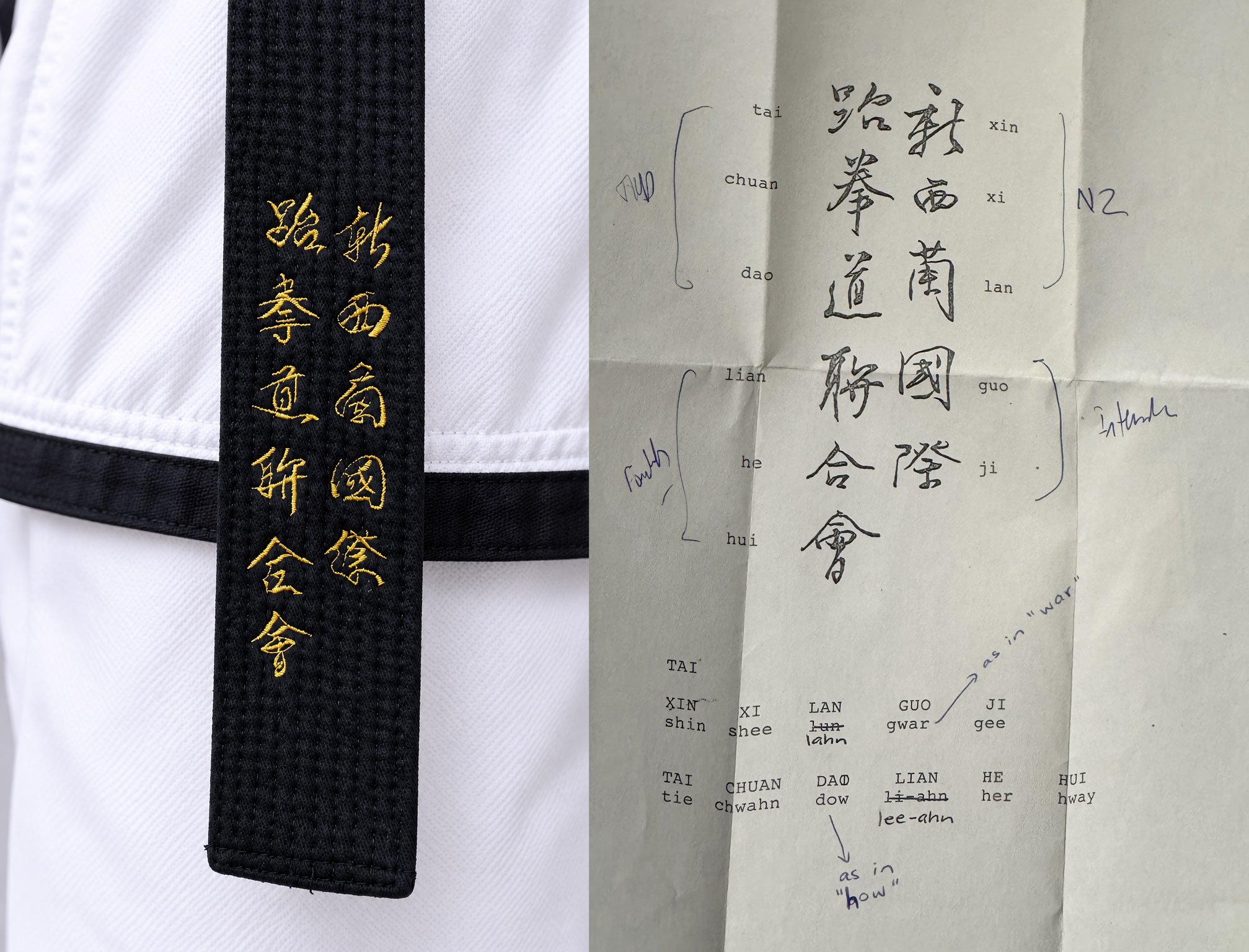
I am often asked about the meaning of the calligraphy embroidered on our ITFNZ black belts.
While many countries use Korean Hangeul for the Taekwon-Do inscription on their black belts, New Zealand has something quite distinctive. Our black belts carry a unique Chinese calligraphy inscription created specifically for our organisation.
There is an interesting historical reason for this.
Although Hangeul is now the standard writing system for the Korean language, Korea has a long tradition of using Chinese characters, known in Korean as Hanja. Before Hangeul was created in the 15th century, Chinese characters were the principal written system used in Korea. Chinese-character calligraphy therefore has a very long and important artistic and cultural tradition in Korea.
This tradition is also reflected in General Choi Hong Hi's own calligraphy. Much of General Choi's calligraphic work was written using Chinese characters, reflecting the historical calligraphic tradition with which he was familiar.
This is important when looking at our own black belt embroidery. The use of Chinese characters connects our Taekwon-Do tradition with the historical East Asian tradition of brush calligraphy that was also part of Korea's cultural heritage.
In around 1990, when we began conducting our own gradings in New Zealand under our own system, we decided to establish some elements that were uniquely our own.
Two of these were:
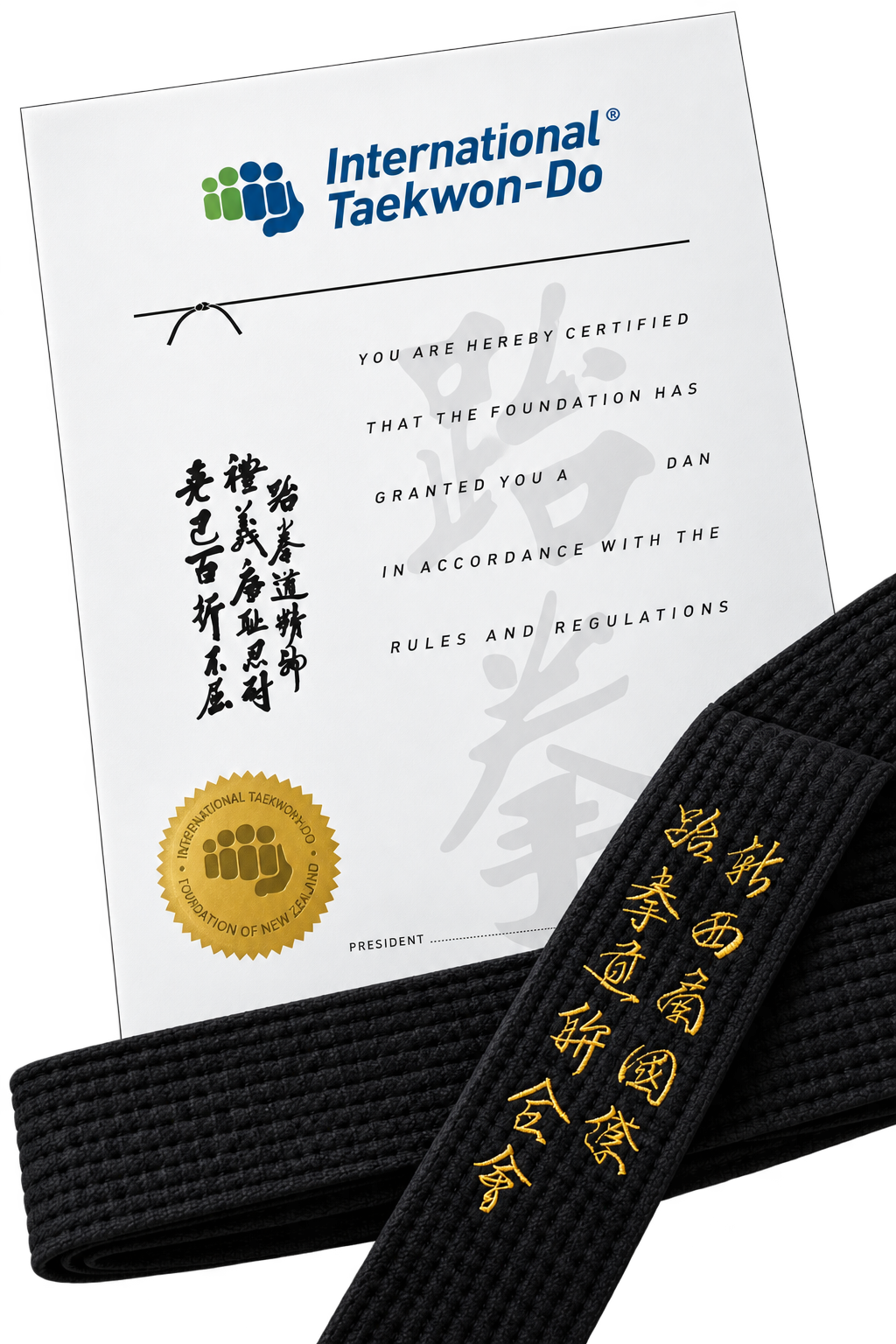
To achieve this, we approached a Chinese professor at the University of Auckland, who agreed to create the Chinese calligraphy that would become the distinctive embroidery on our black belts. She was asked to create a stylised Chinese version of:
International Taekwon-Do Foundation of New Zealand
The original notes from this project have survived, including her handwritten explanations of the meaning and pronunciation of the individual characters. They give us a fascinating glimpse into how the embroidery on our belts was created.
The inscription is written in traditional Chinese characters:
The individual parts are:
The inscription therefore conveys the meaning:
The word order is different from the English name because the Chinese rendering follows Chinese naming conventions, with New Zealand placed at the beginning as the geographical designation of the organisation.
For more than three decades, these belts have been worn by New Zealand black belts.
That makes the calligraphy more than simply a translation of our organisation's name. It has become part of the identity and history of ITFNZ.
Every black belt represents the individual's achievement, dedication and years of training. But for an ITFNZ black belt, the belt also carries something else - a small piece of our own history.
The calligraphy is unique to New Zealand. It was created specifically for our organisation, and the original handwritten notes documenting its creation have now survived for more than 30 years.
So when you wear an ITFNZ black belt, you are not simply wearing a symbol of your own rank. You are wearing something that connects you to the history of Taekwon-Do in New Zealand - and to the generations of New Zealand practitioners who have worn the same distinctive calligraphy before you.
That is something worth taking pride in.